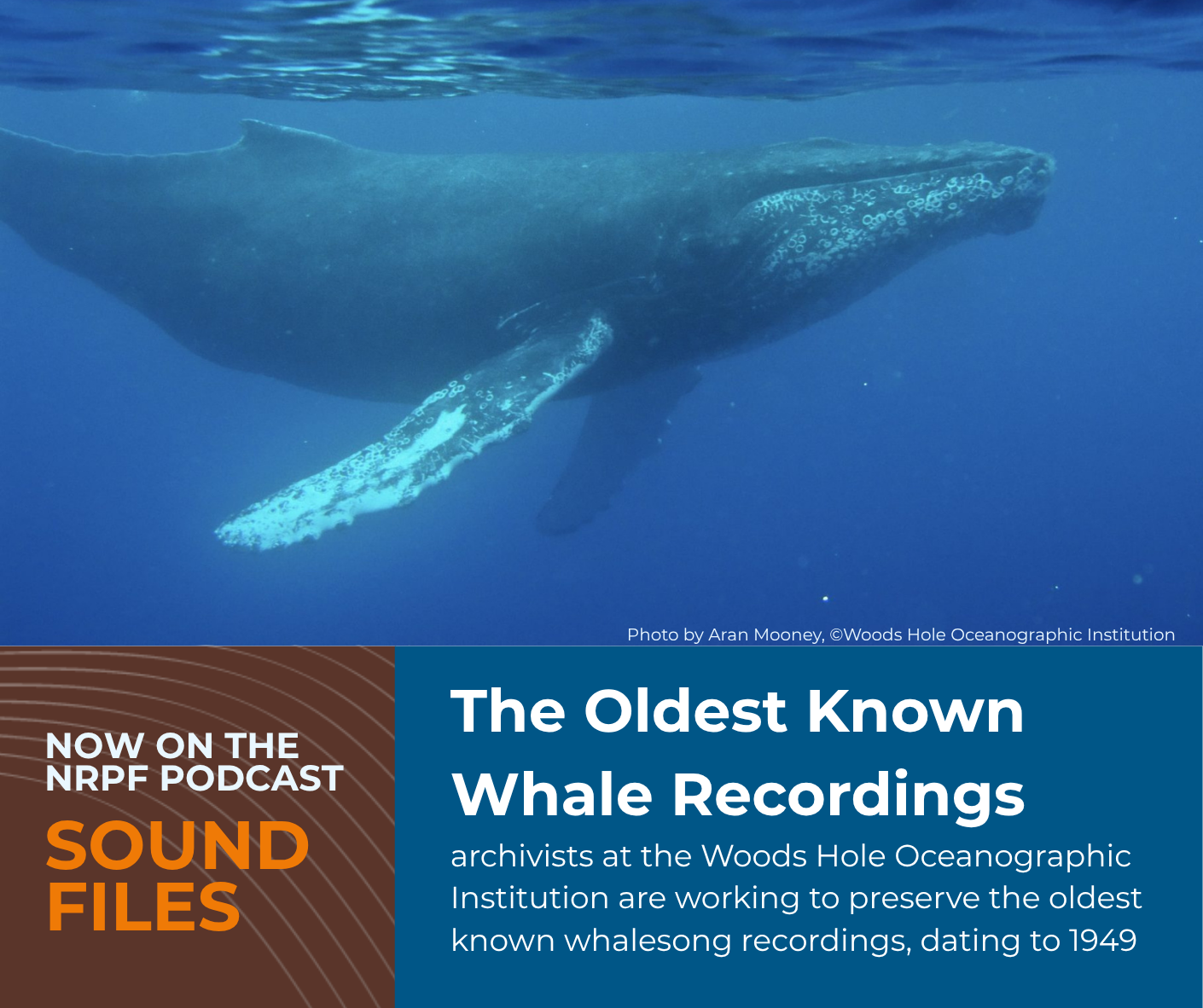
Join Sound Files for this dive into a remarkable project that has led to the preservation of the oldest known audio recordings of humpback whale songs, made in 1949. These were made using technology that wasn’t developed for scientific sound recording, but rather for office dictation, and they were rediscovered at the Woods Hole Oceanographic Institution (WHOI). You’ll hear how archivist Ashley Jester stumbled upon these forgotten audio discs while leading tours, and how digitization expert Paul Adams determined that the “fish noises” were actually whale songs.
These seven-decade-old recordings show us how listening matters for understanding ocean life in the past and today. How do you “listen” to sounds underwater? When did people start making underwater sound recordings? And how has the underwater “soundscape” changed over time? These are just a few of the big questions that this episode dives into!
Further examples of the audio recordings, photos from the WHOI archives, and a short film about the preservation work can be found at the WHOI web site.
Listen Now
Follow & Subscribe


Episode Credits
Sound Files is presented by the National Recording Preservation Foundation (NRPF) and generously supported by the University of Michigan School of Information.
Jesse Johnston, creator of Sound Files and a Clinical Assistant Professor at the University of Michigan School of Information, hosts the podcast. Teresa Carey is the senior producer, editor, and creative lead for Morse Alpha Studios, which produced this podcast. Writing is by Jacob Pinter, and sound engineering by Steve Lack. Original music by Evan Haywood.


